
Dorcas Babet Kwofie shares about their postgraduate research work done in collaboration with YouthLink Scotland and Binks Hub on the role of youth work in tackling child poverty in Scotland.

Child poverty isn’t just a statistic you see in a report. It looks like a child going to bed hungry, a teenager missing a school trip because their family can’t afford it or a young person carrying stress far beyond their years. While these struggles often go unseen, youth workers across Scotland see them every day and they step in, quietly but powerfully, to help.
Over the last year I have been carrying out research in collaboration with YouthLink Scotland and Binks Hub on the relationship between youth work and child poverty in Scotland. It involved interviews with youth workers based across the Scotland. When I carried out my research with youth workers across the country, I expected to hear about funding pressures and social challenges. What I didn’t expect was how deeply committed youth workers are to walking alongside young people through some of the hardest moments of their lives. The stories of these workers revealed both the harsh reality of poverty, and the incredible difference youth work can make.
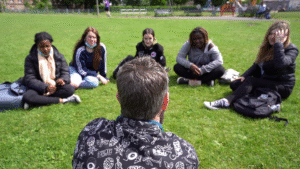
One thing youth workers were clear about is that child poverty is not caused by poor choices or lack of effort. It is rooted in bigger systems; rising rents, higher council tax, low wages, and the long-term effects of economic decline. As one youth worker told me :
“Young people who were just managing before are now slipping below the poverty line. They’re not coping the way they used to.” For many young people, poverty doesn’t exist on its own. It overlaps with disability, racism, gender inequality, and rural isolation. These layers make everyday life even harder, from accessing healthy food and safe spaces to staying engaged in education. Because of their presence and knowledge of local communities, youth workers notice the small things others might miss such as worn-out clothes, empty lunch boxes and young people who stop showing up because they feel ashamed. Instead of judging, youth workers respond with care, creativity, and advocacy.
Youth work in Scotland isn’t about ticking boxes or running rigid programs. At its heart, it is about relationships. One-to-one mentoring is often the starting point. A youth worker becomes a trusted adult – someone who listens, supports, and believes in a young person when the world around them feels overwhelming. These relationships help young people build confidence, resilience, and hope for the future. One youth worker summed up this shift in confidence beautifully;
The research also revealed that group activities matter. Youth workers interviewed shared the importance of workshops and youth-led projects. In these spaces young people don’t just receive support; they help shape it. They learn life skills, explore career options, and develop the confidence to speak up and make decisions. This kind of learning reflects the ideas of educator Paulo Freire, who believed that education should be a conversation, not a lecture. In youth work, learning happens through real experiences, teamwork, and reflection; helping young people see their own strengths and their ability to change their circumstances.
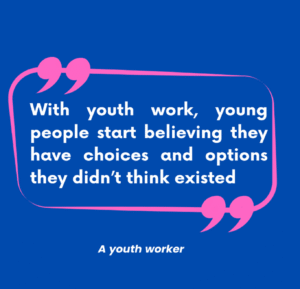
Sometimes support has to be practical before anything else can happen. Many of the youth workers I spoke to described providing meals, clothes, transport vouchers, or access to safe spaces where young people can simply be warm, fed, and supported. These things may seem small, but they remove huge barriers to school attendance, social life, and overall wellbeing.
Community projects also play a big role. Cooking clubs, youth hubs, and employability schemes give young people opportunities to build skills, connect with others, and develop a sense of belonging. When young people help design and lead these projects, it builds confidence and challenges the idea that they are just “recipients” of help. Instead, they become active contributors in their communities.
Youth work bridges immediate needs with long-term empowerment. Beyond meeting basic needs, it includes mentoring, workshops, advocacy, and other forms of support that help young people grow, build skills, and take part in shaping their futures.

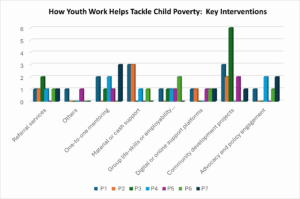
The chart below shows how youth workers described this balance in practice. While material support such as food, clothing, and transport was an important part of their work, it sat alongside relationship-based and developmental approaches like one-to-one mentoring, group life-skills and employability workshops and advocacy. This reflects how youth work does not stop at crisis response. Instead, practical help often becomes the foundation that allows young people to take part in wider opportunities- from education and training to community decision-making. The range of interventions shown highlights how youth work responds to poverty both by easing immediate pressures and by expanding young people’s confidence, voice, and future possibilities.
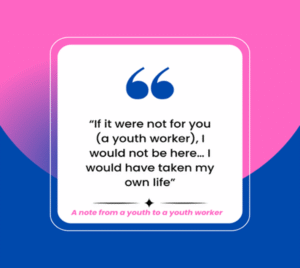
Sometimes the impact of youth work is captured in a single moment. Quotes like the one shared here carry weight. They point to a kind of influence that is rarely immediate or easily measured – the quiet, relational work that stays with a young person long after a project ends. Youth work often unfolds slowly, through trust, consistency, and simply being there at key points in a young person’s journey. Stories like this help us understand why youth work matters so deeply. It does more than respond to crises; it creates space for young people to grow in confidence, recover from difficult experiences, and begin to imagine different futures. For those living with poverty and instability, having a trusted adult who listens without judgement can be a turning point.
Yet this life-changing work happens under significant pressure. Youth workers described facing ongoing challenges that limit what they can provide. Short-term funding leads to uncertainty and disrupts relationships, while heavy workloads and the emotional intensity of supporting young people in crisis contribute to stress and burnout. Despite working at the frontline of issues linked to poverty, inequality, and mental health, youth work is still often overlooked in national policy and funding decisions.
There is a clear tension here: youth work is relied upon to address increasingly complex needs, but without the stability and recognition it deserves. Even so, its potential remains enormous. With sustained funding, stronger partnerships, and a greater voice in policymaking, youth work could play an even more transformative role in tackling child poverty – strengthening not only individual life chances, but the wellbeing of whole communities.
If Scotland is serious about reducing child poverty, youth work must be part of the solution. That means: investing in training and wellbeing for youth workers, supporting long-term relationships with young people, working closely with schools, housing, and mental health services and including youth work in national anti-poverty strategies. Most importantly, it means listening to young people themselves. Youth work does more than help young people survive. It helps them believe they matter and that they have the power to shape their own future. That is how real change begins.

This blog is based on the author, Dorcas Babet Kwofie’s postgraduate research work done in collaboration with YouthLink Scotland and Binks Hub on the role of youth work in tackling child poverty in Scotland.