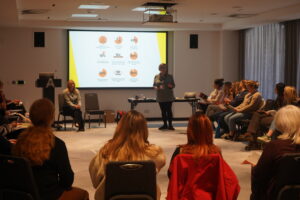
Vicki Ridley, Senior Development Officer at YouthLink Scotland blogs about her workshop with Stacey Gordon from the Scottish Borders CLD Team recently at the National Youth Work Conference.
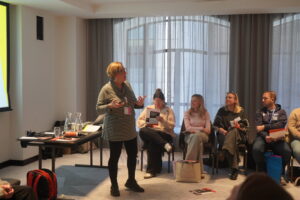
Standing in front of a room full of youth workers and managers at the 2025 National Youth Work Conference, I felt a familiar mix of excitement and curiosity. Together with Stacey Gordon from the Scottish Borders CLD Team, I was there to share the findings from Year 4 of the Imagine a Man project, an initiative that has been close to my heart for years. Having worked in community-based youth work organisations for much of my career, I’ve seen first-hand how conversations about masculinity can open doors for young people, if we create the right conditions.
From the beginning, Stacey and I wanted this workshop to feel participatory and alive. Rather than delivering a static presentation, we built in activities that encouraged everyone to speak, move, and reflect. We talked about “Brave Spaces”, places where we can explore sensitive topics without fear of judgment, and where honesty and curiosity take priority over comfort.
Our focus was on upstream solutions, looking at how we, as youth workers, can nurture the conditions that help boys and young men flourish. Over the years, I’ve learned that youth work isn’t just about reacting to crises; it’s about shaping cultures of care and understanding. When we model empathy, challenge stereotypes, and show young people that vulnerability is not weakness, we create pathways for healthier masculinities to emerge.
One of the most powerful parts of the session was sharing the voices of the young men involved in Imagine a Man. Their reflections over the past four years have been thoughtful, raw, and often deeply moving. They’ve spoken about friendship, about love, pressure, belonging, and what it really means to “be a man” in today’s world. As I spoke their words aloud, I was struck again by how open and brave they’ve been in exploring these questions.
It’s something I’ve become more conscious of over time, how easily adults can unintentionally edit or skip over young people’s words, perhaps to make them sound more polished or palatable. But doing that, even subtly, can send the message that certain feelings or experiences aren’t acceptable to express.
As the discussions unfolded, what stood out to me most was how willing people were to sit with uncertainty, to admit they didn’t have all the answers but were ready to explore anyway. That, to me, is the essence of brave work. We don’t need to arrive with fixed definitions of masculinity; we just need to stay curious and open.
After four years of Imagine a Man, I can see the ripple effects, in how practitioners listen and in how young men express themselves, and in how we’re collectively reimagining what masculinity can look like. When we create space for honest conversation, we don’t just talk about change, we live it, one dialogue at a time.