
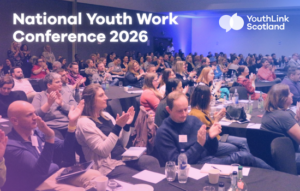
This year’s National Youth Work Conference will take place in Glasgow on Monday 2nd November. The theme is “Before Crisis: Youth Work and Young People’s Mental Health”. This event is now fully booked and a reserve list is in operation.
Across Scotland, young people are experiencing growing pressures on their mental health and wellbeing. Anxiety, trauma, loneliness, poverty, digital pressures, family stress and uncertainty continue to shape young people’s lives.
Youth workers are often the trusted adults supporting young people before needs escalate. Through relationships, safe spaces, informal education and community support, youth work provides vital early intervention and prevention.
At the same time, innovative partnership projects are emerging across Scotland, bringing together youth work, health, education and community services in new ways. There is also increasing interest from researchers and policy makers in preventative, relationship-based models of support.
This conference will bring together practitioners, academics, pioneering projects and policy leaders to shape a stronger national response.
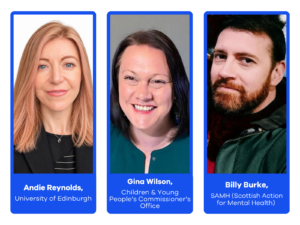
Andie Reynolds, University of Edinburgh; Gina Wilson, Children & Young People’s Commissioner’s Office; and Billy Burke, SAMH (Scottish Action for Mental Health)
This forward-looking discussion will bring together leading voices to explore what the next chapter of policy on young people’s mental health should look like. Do we need to go further on prevention and early intervention? Should youth work and community-based support play a much bigger role? Are our services, systems and investment keeping pace with what young people actually need – or is it time for more radical reform?
We’ll look beyond the pressures of today to ask what Scotland could do differently, what government and the wider system need to move on, and what it would take to build an approach that supports young people earlier, wherever and whenever they need it.
Professor Sir Gregor Smith, Chief Medical Officer for Scotland
We’re delighted to welcome Scotland’s Chief Medical Officer, Professor Sir Gregor Smith, for a keynote exploring one of the biggest questions facing us: how can we better protect and support young people’s mental health before they reach crisis point?
Building on the themes of his latest annual report, Our Path Ahead, Professor Smith will reflect on the importance of prevention, early intervention and the wider conditions that help young people to thrive – and why improving mental health cannot be the responsibility of health services alone.
His keynote will consider the role that trusted relationships, safe spaces and community-based support can play, the contribution of youth work to Scotland’s preventative approach, and the opportunities to strengthen connections between youth work, public health and government.
With prevention increasingly central to Scotland’s approach to public service reform, this is an important opportunity to hear directly from the Chief Medical Officer about the future of young people’s mental health – and where youth work can fit within it.

Louise Holly – Research and Policy Coordinator, Digital Transformations for Health Lab (DTH-Lab)
Internationally recognised global health researcher and policy expert Louise Holly will share insights from the latest research into the digital determinants of young people’s mental health and wellbeing, including emerging findings being published in The Lancet.
With more than 20 years’ experience in global health policy, research and advocacy, Louise has worked with organisations including WHO Europe, UNICEF and Save the Children, and supported the Lancet and Financial Times Commission on Governing Health Futures 2030.
Drawing on this international expertise, her keynote will explore what the latest evidence tells us about the risks and benefits of social media and digital technologies, why some young people are more vulnerable to harm, and where current approaches are falling short. Crucially, she will look beyond placing responsibility on young people and families and consider what a stronger public health and preventative approach could look like, from safer digital environments and greater accountability for technology companies to ensuring young people have a meaningful voice in shaping the digital world they inhabit.

The UK will be rejoining Erasmus+ in January 2027. Join the British Council, the UK National Agency for Erasmus+, to find out about the transformative opportunities for young people and practitioners through this funding programme. Erasmus+ can support youth exchanges, youth participation activity, youth worker training and study visits and more.
This information seminar is optional, and will take place during part of the lunch break.
Facilitators: Aberdeen City Council
This workshop will introduce delegates to what Growing2gether is and how the partnership with youth work developed. Attend this workshop to understand how Growing2gether in partnership with youth work can deliver outcomes for young people in relation to mental health and post-school transitions.
Aims:
Facilitators: Laura Alexander and Mark Hunter, Fast Forward
Explore the links between risk-taking and harmful behaviour and children and young people’s mental well-being. This workshop will focus on how we can support children and young people to adopt healthy coping strategies in times of crisis, in place of unhealthy coping mechanisms.
Aims:

Facilitators: Felicity Hughes and Sadia Hussain-Savuk, Intercultural Youth Scotland
This workshop will share the development of Intercultural Youth Scotland’s anti-racist mental health intervention for young people, exploring how lived experience, evidence, partnership working and trauma-informed practice informed the programme.
Aims:
Facilitators: Paula Manners and Isabelle Huggan, LGBT Youth Scotland
This workshop will present the idea that one of the key roles of youth work is to support young people to build a ‘life worth living’ – that is a life full of joy, fun, meaning, purpose and relationships.
Aims:

Facilitators: George Campbell, Kiera McCallum, George Gibson and Lily McKee, Regen:FX GOTO Mental Health Service for Young People
What can young people teach us about relationship-based youth work and positive mental health? This workshop will explore how youth work can move beyond providing support to enabling participation, achievement and lasting positive outcomes.
Aims:

Facilitators: Claire Wadsworth, Megan McGarrigle, Chloe Haney and Jennifer Campbell, Grow Your Own Routes: Scottish Families Affected by Alcohol and Drugs
This interactive workshop will explore the experiences of young people aged 12–26 who are affected by another person’s alcohol or drug use, with a particular focus on the impact on mental health and wellbeing.
Aims:
PRICES
£110 including VAT (YouthLink Scotland Members) and £130 including VAT (Non-members). THIS EVENT IS NOW FULLY BOOKED AND A RESERVE LIST IS IN OPERATION.
