
Last Friday (22nd May), at The Citadel in Leith, there was a conversation that felt both urgent and hopeful. Young people, youth workers, parents and grandparents gathered with Kanishka Narayan MP, Parliamentary Under-Secretary of State (Minister for AI and Online Safety) to talk honestly about growing up online – the pressures, possibilities and harms that increasingly shape young people’s lives.
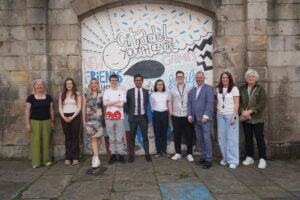
Last Friday (22nd May), at The Citadel in Leith, there was a conversation that felt both urgent and hopeful. Young people, youth workers, parents and grandparents gathered with Kanishka Narayan MP, Parliamentary Under-Secretary of State (Minister for AI and Online Safety) to talk honestly about growing up online – the pressures, possibilities and harms that increasingly shape young people’s lives.
What emerged was not a simple argument for or against social media. Instead, it was a recognition that online life is now inseparable from young people’s everyday experience. For many young people, social media offers connection, creativity and community. Yet the discussion also laid bare the growing concerns around misinformation, online abuse, exposure to harmful content, mental health pressures and the ways in which online conflict can spill over into real-world violence.
The visit offered a valuable opportunity for ministers to hear directly from those living and working closest to these issues. Youth workers from The Citadel demonstrated the depth of trust they have built with young people and the critical role they play in helping them navigate digital spaces safely and confidently. Parents and grandparents spoke candidly about the challenges of keeping pace with a fast-changing online world, while young people themselves offered their reflections.
For YouthLink Scotland, the conversation reinforced a message that has been building for years: legislation alone will not solve the challenges of growing up online.
There is no doubt that stronger regulation of social media companies is required. Platforms must take greater responsibility for the content they promote, the algorithms they deploy and the environments they create for young people. Evidence-led and rights-respecting regulation is essential if young people’s safety and wellbeing are to be properly protected.
But regulation is only one part of the response.
If young people are to spend less time in unhealthy online spaces, they need meaningful alternatives – places to belong, opportunities to connect and activities that build confidence and purpose. Youth work provides exactly that. Across Scotland, youth workers create safe spaces where young people can build friendships, explore identity and develop resilience away from the pressures of online performance and comparison.
Equally, in an age of AI-generated content, misinformation and growing distrust, young people need support to develop critical thinking skills. They need spaces where they can question what they see online, understand how digital systems shape their experience and discuss complex issues in ways that relate to their real lives. Again, youth work is uniquely placed to do this because it starts with relationships, trust and lived experience.
And when online harms do occur – whether cyberbullying, exploitation, mental health impacts or exposure to harmful content – young people need trusted adults who can help them process those experiences and recover from them. For many young people, youth workers are precisely those trusted adults.
Scotland’s youth work sector has been leading in this area for more than a decade. YouthLink Scotland has worked with partners across the UK and Europe to help define Digital Youth Work and support practitioners to engage confidently with young people’s online lives. The work happening at The Citadel is an outstanding example of what that looks like in practice: informed, relational and rooted in young people’s realities.
The challenge now is ensuring that youth work is recognised not as an optional add-on to online safety policy, but as an essential part of the national response.
The conversation at The Citadel was a reminder that while technology continues to evolve rapidly, the fundamentals remain unchanged: young people need connection, trusted adults, critical thinking skills and places where they feel they belong. Youth work delivers all of these – and that is why it must be central to any serious conversation about growing up online.