
This is the first in a series of three pieces highlighting what must change to ensure every young person in Scotland can access high-quality youth work: guaranteed by law, available in every community, and sustained by long-term investment. Ellie Craig MSYP, Chair of the Scottish Youth Parliament, whose recent address to Parliament set out why youth work is not simply valuable, but essential.
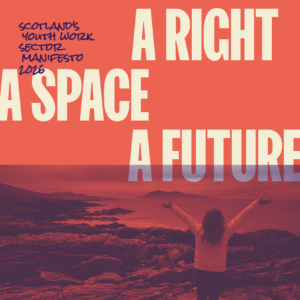
This is the first in a series of three pieces highlighting the core commitments of our manifesto — A Right, A Space, A Future.
Together, they set out what must change to ensure every young person in Scotland can access high-quality youth work: guaranteed by law, available in every community, and sustained by long-term investment .
We begin with A Right — because without a clear, legal entitlement, access to youth work will continue to depend on chance rather than need.
A Right: Ellie Craig MSYP, Chair of the Scottish Youth Parliament
In the final Time for Reflection of this parliamentary session, MSPs heard directly from a young person whose life has been shaped by youth work, and whose message could not have been clearer.
Ellie Craig, Chair of the Scottish Youth Parliament and MSYP for Glasgow Cathcart, addressed the chamber with a speech that was at once deeply personal and sharply focused on what young people across Scotland need.
Speaking about loss, isolation and finding her voice, Ellie set out why youth work is not simply valuable, but essential.
Her speech comes as part of a growing call for change, and speaks directly to the first of our manifesto asks: A Right — a legal right to youth work for all young people.
Her words speak for themselves.
Ellie Craig (Scottish Youth Parliament)
Good afternoon, everyone. I am the chair of the Scottish Youth Parliament and MSYP for Glasgow Cathcart. I am honoured to be part of the final time for reflection in this session of Parliament.
A few weeks ago, I was here in the chamber filming a podcast with the Presiding Officer as part of her legacy work. Next month, I will have served as a member of the Scottish Youth Parliament for seven years, and, in around six months, my term as chair and time as an MSYP will come to an end.
Preparing for today’s speech got me reflecting on what I would like my legacy to be. I was first elected to the Scottish Youth Parliament when I was only 15. Back then, I had little confidence in myself. As a young carer for my mum, who seemed to be balancing a lot more responsibility than my peers, I often felt isolated and like no one understood what I was going through.
Just after the pandemic, in 2021, I lost my mum, Anne. I was only 17, just leaving high school and trying to figure out where I fit in the world. Without the support of youth work services, I do not quite know whether I would have survived. Now, in 2026, as chair of the democratically elected voice of Scotland’s young people, decision makers and those in power often ask me what I think of the problems regarding community and social cohesion. My response is always the same: there is a lack of support for young people when the world around us seems to be crumbling.
Members in this chamber voted unanimously to incorporate into legislation the United Nations Convention on the Rights of the Child. As an MSYP, I am incredibly proud that, in Scotland, we have made it a legal right for young people to meet their peers, to join groups and organisations, to play and to learn.
However, that has not stopped the disinvestment in youth work services, which is having a detrimental impact on young people’s education, employment and mental health. That impact is not felt equally. For me, and for many other young people from seldom-heard groups, support from youth work services is essential. Those spaces allow young people to be young people, to make friends, to build skills and to make change in our communities.
Behind those youth work services are youth workers. They are often unthanked, uncelebrated and underpaid. However, I can safely say that, without the support and encouragement of a number of different youth workers over the years, I would not be the person that I am today.
I stand here as a product of great youth work. The opportunities to use my voice, which so often went unheard, have allowed me to succeed. Every young person in Scotland deserves access to the support they need, not only to survive but to thrive—not because it is a nice thing to have, but because we made it their right.