
This is the third in a series of three pieces highlighting what must change to ensure every young person in Scotland can access high-quality youth work: guaranteed by law, available in every community, and sustained by long-term investment. Jimmy Paul, Head of the Scottish Violence Reduction Unit writes about why spaces for young people are so crucial, echoing the calls in the Youth Work Sector’s Manifesto, — A Right, A Space, A Future.
This is the third in a series of three pieces highlighting the core commitments of our manifesto — A Right, A Space, A Future.
Together, they set out what must change to ensure every young person in Scotland can access high-quality youth work: guaranteed by law, available in every community, and sustained by long-term investment .
Jimmy Paul, Head of the Scottish Violence Reduction Unit writes about why spaces for young people are so crucial, echoing the calls in the Youth Work Sector’s Manifesto, — A Right, A Space, A Future.
Alexander Den Heijer once said: “When a flower doesn’t bloom, you fix the environment in which it grows, not the flower.” To help young people flourish, we must be the architects of a landscape that supports them.
This is why I love YouthLink Scotland’s call for ‘A Space’. It is vital. This is about the literal ground upon which a safer Scotland is built, and how we use it to change lives for the better.
Since joining the SVRU, my colleagues and I have spent a lot of time with young people. Many describe life as navigating increasingly choppy and unpredictable waters: the pressures of digital life, a rapidly changing job landscape, and the impact of the cost-of-living crisis on their families. I often say that change has never been this fast, but it will never be this slow again.
One thing we know is that dedicated youth spaces act as anchors. Young people consistently tell us that access to a community centre, a school hall after hours, or a youth hub makes the world feel brighter and more manageable. These spaces enable relationships to grow and give young people a sense of connection and safety. As Gabor Maté says: “A child cannot be taught or thrive in a state of fear. Safety is not the absence of threat; it is the presence of connection.”
Safe spaces provide stability – a consistent place and time that offers rhythm and reassurance. They are shared sanctuaries: places to meet with friends, build new relationships and develop skills. Crucially, they allow young people to be seen as individuals with potential.
We also know that violence is often the result of a long chain of missed opportunities. By the time intervention is needed, many chances for connection have already passed. Our responsibility is to ensure those connections happen early and often, providing the love and belonging every young person deserves.
In environments where young people feel safe, youth workers can build trust and notice the early signs of distress – the quiet signals that might overwise go unseen until crisis point. Valuing these spaces means valuing the young people within them. As the founder of the unit John Carnochan said: “We must remember that whatever the question, the answer is relationships.”
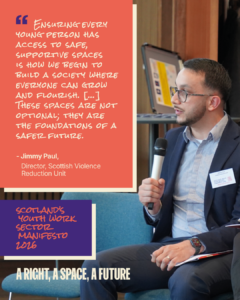
If environments and relationships can harm, they can also heal. Ensuring every young person has access to safe, supportive spaces is how we begin to build a society where everyone can grow and flourish. YouthLink Scotland’s call for universal access to spaces — free, fair, and consistent — is a practical and necessary solution. These spaces are not optional; they are the foundations of a safer future.
Imagine a Scotland where every young person knows there is a place waiting for them – not conditional, not limited, but guaranteed. A place where they are known by name, not defined by circumstance.
Imagine a Scotland where connection is built into everyday life, not something found only in crisis. Where belonging is intentional.
That is the Scotland we can choose to build — if we choose to build it together.
Read the first in the series by Ellie Craig MSYP, Chair of the Scottish Youth Parliament, whose recent address to Parliament set out why youth work is not simply valuable, but essential. Drawing on her own experience, she highlights the importance of consistent support for young people and the need to ensure access is based on need, not chance.
Read the second in the series by Peter Kelly, Chief Executive of The Poverty Alliance writes about A Future – Sustained and Increased Investment in Youth Work and why youth work is an essential service for Scotland’s young people, especially for those growing up in poverty.